Every unanswered phone call in your business is a customer deciding whether to wait for you or call your competitor. For most small businesses in Halifax and across Atlantic Canada, that decision is being lost to voicemail far more often than owners realize. Here is what an AI receptionist does, the Canadian numbers behind the shift, what it costs, and the Nova Scotia funding programs that may help.
The hidden cost of a missed call in Atlantic Canada
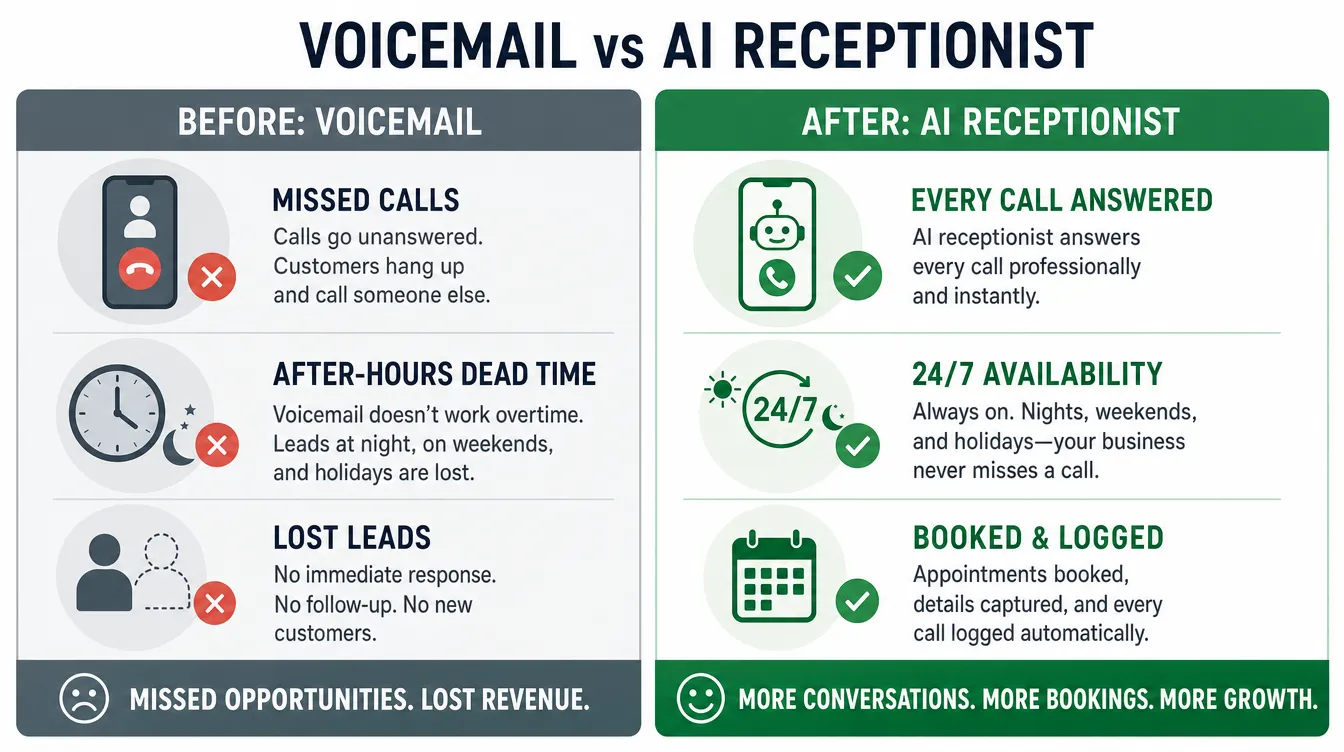
For a service business — a plumber, a dental clinic, a law firm, a landscaping company, a salon — the phone is still the front door. But that front door is open only when someone is free to answer it. Industry research on home-service and trades businesses consistently finds that more than half, and in many cases 60 to 80 percent, of inbound calls go unanswered, usually because the team is already on a job, with a client, or closed for the day.
The problem is that callers rarely try twice. Studies of phone behaviour show that the large majority of people who reach voicemail simply hang up and call the next business on their search results. And these are not low-value contacts: phone leads tend to convert far more often than web-form leads, because someone who picks up the phone is usually ready to book, buy, or hire today. For a typical local service business, a meaningful share of all new business still arrives by phone.
Put those two facts together and the math gets uncomfortable. If your average job is worth a few hundred to a few thousand dollars, even a handful of missed calls a week quietly adds up to tens of thousands of dollars in lost revenue over a year — revenue you already paid marketing dollars to generate.
What an AI receptionist actually does
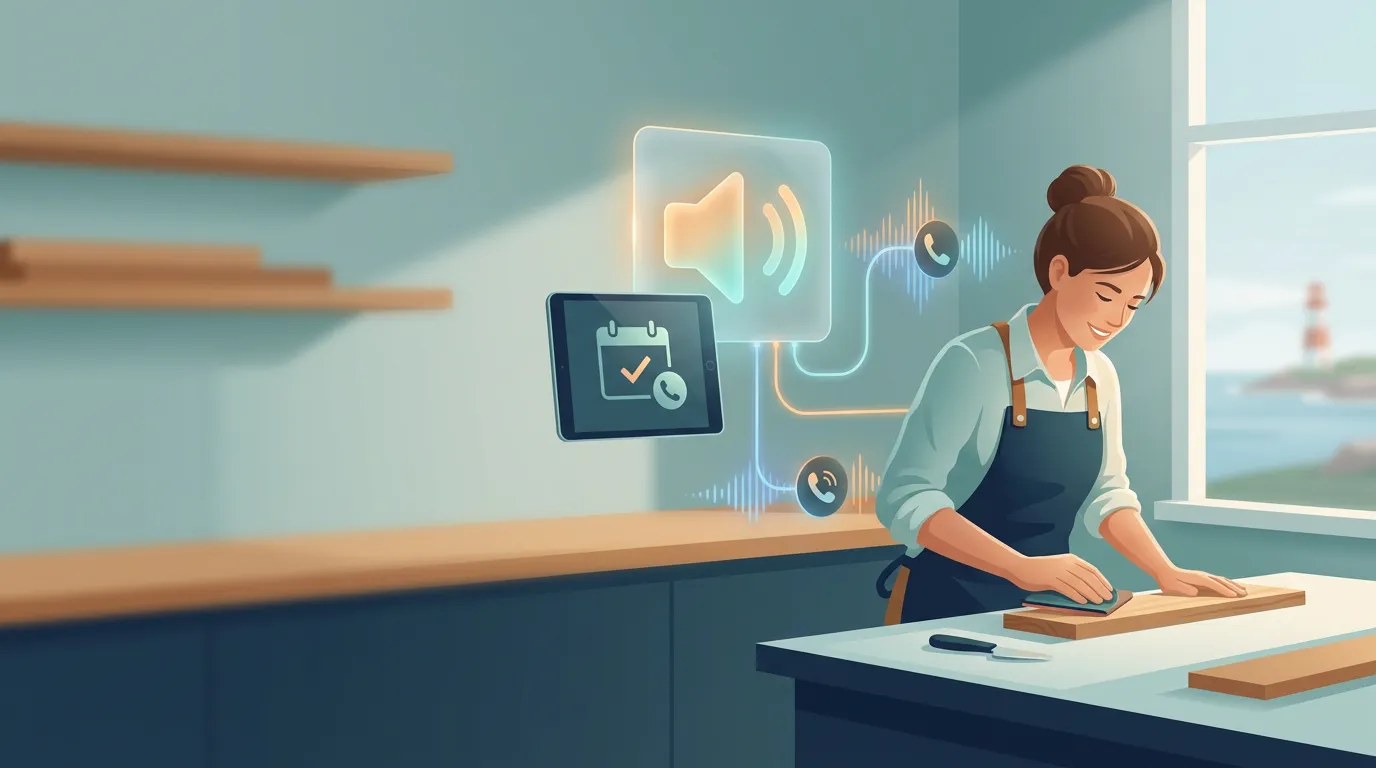
An AI receptionist is a conversational voice agent that answers your business phone in a natural, human-sounding voice — instantly, around the clock, and on every call at once, even when three people ring at the same time. Unlike the old touch-tone menus everyone hates, it understands plain language and holds a real back-and-forth conversation.
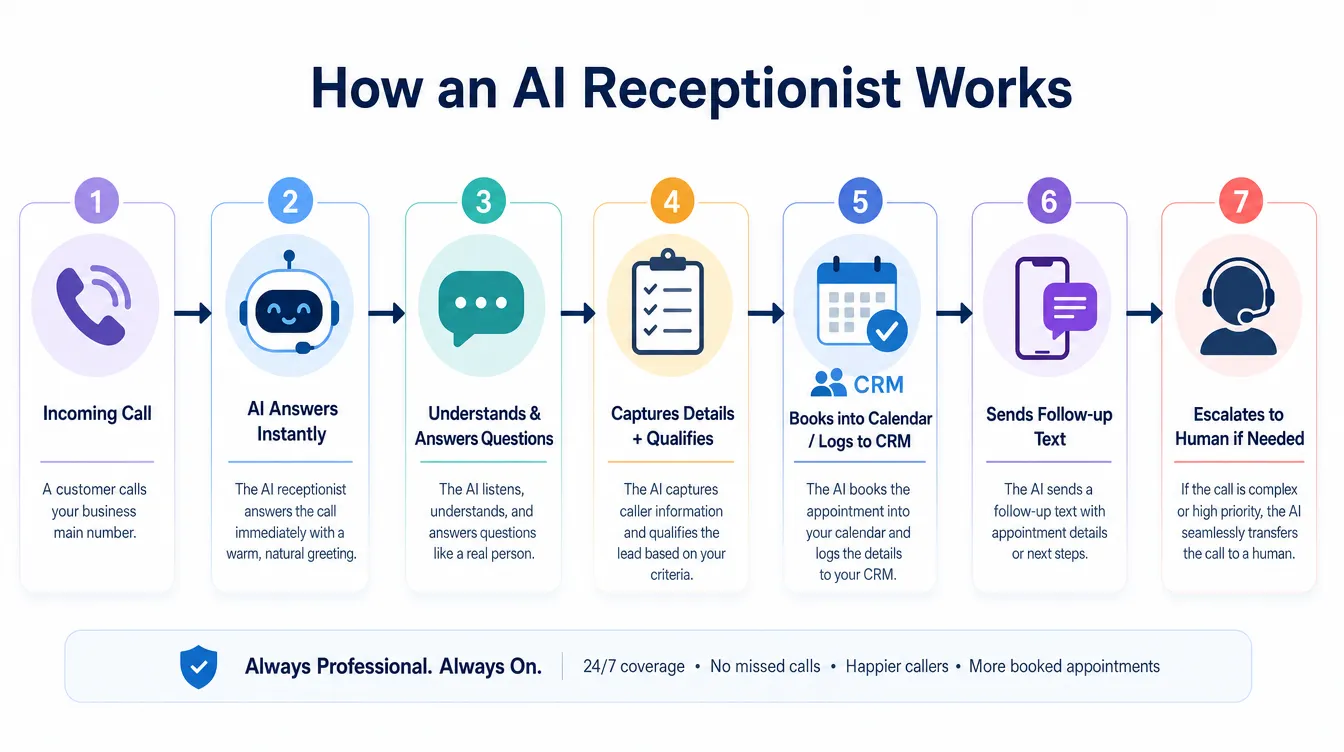
A well-configured AI receptionist will:
- Answer immediately, greet the caller in your business’s voice, and never put anyone on hold.
- Answer common questions — hours, location, pricing, services, parking — from a knowledge base you provide.
- Capture the caller’s name, number, and reason for calling, and log it straight into your CRM and lead pipeline.
- Book appointments directly into your calendar so the slot is confirmed before the call ends.
- Send an instant follow-up text or email, and route or escalate urgent calls to a human when needed.
- Work 24/7 — capturing the after-hours and weekend calls that currently go straight to voicemail.
In other words, it is not a robot reading a script. It is an always-on front desk that turns calls you are currently losing into booked, qualified opportunities.
The numbers: why Canadian small businesses are adopting AI now
AI has moved from novelty to mainstream business tool in Canada faster than most owners expected. According to Statistics Canada, roughly 12 percent of Canadian firms were using AI to produce goods or deliver services in 2025 — about double the share from the year before — with a further 14 to 15 percent planning to adopt within the following year. The Business Development Bank of Canada has reported that the overwhelming majority of small and medium-sized businesses that have adopted AI say it has delivered real, tangible benefits.
That said, Canada still trails many peer economies on adoption, which is exactly where the opportunity lies for local businesses: the owners who move first capture the advantage before their competitors catch up. The Canadian Federation of Independent Business has noted that a majority of small businesses plan to maintain or increase their spending on automation and technology heading into 2026.
For phone handling specifically, the case is straightforward. Analyses of AI phone-answering systems report that they can cut missed calls dramatically — on the order of three-quarters — and that the global virtual-receptionist market, valued in the billions, is growing steadily year over year as the technology becomes standard infrastructure rather than an experiment.
What it costs — and the return
Pricing for AI voice-answering services has dropped sharply. Entry-level plans for a single business line now commonly start in the range of roughly CAD $40 to $150 per month, with higher tiers priced by call volume or minutes for busier operations. Compare that to the cost of a full- or part-time receptionist, a traditional answering service, or — most importantly — the revenue from jobs you are currently losing to voicemail.
The return is usually easy to see. For most service businesses, capturing a single job that would otherwise have been missed pays for months of service. That is why the payback period for AI phone answering is typically measured in weeks, not years.
Funding and grants for Nova Scotia businesses (2026)
One question we hear constantly from Halifax and Atlantic Canada business owners: are there grants for this? The honest answer is “sometimes, indirectly” — and it pays to understand the landscape, because some of the programs people still search for no longer exist.

First, a correction many businesses need: the federal Canada Digital Adoption Program (CDAP), including its “Boost Your Business Technology” $15,000 grant, stopped accepting new applications in February 2024 and has since wound down. If a vendor or article is pointing you to CDAP for a new project in 2026, that information is out of date.
Here are programs that have been active in Nova Scotia in 2026 and may apply to a technology-adoption project like this — particularly the training and productivity components of implementing a new system. Always confirm current eligibility, intake dates, and terms directly with the program before relying on them:
- Workplace Innovation and Productivity Skills Incentive (WIPSI) — a provincial program that funds a substantial share (commonly up to 75 percent) of eligible training costs, with eligible activities that explicitly include digital transformation and technology adoption alongside skills training. Useful for the staff-training side of rolling out an AI receptionist and the workflows around it. Intakes are scheduled periodically through the province.
- Canada-Nova Scotia Job Grant — a cost-shared grant that helps employers pay for third-party training tied to job outcomes. It can help cover training your team on new systems and processes.
- Invest Nova Scotia — Productivity and Innovation Voucher Program (PIVP) — vouchers (Tier 1 up to $15,000, Tier 2 up to $25,000) that help eligible Nova Scotia SMEs pursue productivity and innovation projects, typically by accessing expertise from post-secondary and research institutions. It has specific eligibility requirements (including an export-oriented plan) and fixed intake windows, so it suits a broader innovation project more than an off-the-shelf purchase.
- Atlantic Canada Opportunities Agency (ACOA) — ACOA offers business development and productivity programs for Atlantic Canadian SMEs, including cost-shared support for productivity and business-skills initiatives. Note that some ACOA support is delivered as repayable contributions rather than grants.
A few honest caveats. Most of these programs are oriented toward training, productivity, and innovation rather than simply reimbursing a software subscription, so the strongest applications frame the AI receptionist as part of a broader productivity or skills-development project with measurable outcomes. Programs like the federal SR&ED tax credit generally apply only to genuine research and custom development work, not to buying an existing tool, and financing programs such as the Canada Small Business Financing Program are loans, not grants.
Sairi Digital Solutions is not a financial or legal advisor, and grant programs, amounts, and deadlines change frequently. Treat the above as a starting point and verify the details with the relevant program administrator or a qualified advisor before you apply or commit.
Is an AI receptionist right for your business?
It is an especially strong fit if you:
- Get meaningful business by phone but regularly miss calls while working, with clients, or after hours.
- Run a trades, home-services, clinic, legal, salon, or appointment-based business.
- Are a solo operator or small team without a dedicated front desk.
- Lose evening and weekend inquiries to voicemail.
It is less essential if nearly all of your bookings already come through online forms and you rarely take calls — though even then, an AI agent can handle the few calls you do get and qualify them instantly.
How Sairi Digital Solutions sets it up
We are a Halifax, Nova Scotia-based digital solutions company, and we handle the whole setup so you do not have to learn the technology. That includes configuring the voice agent in your brand’s tone, loading it with your services and FAQs, connecting it to your booking calendar and CRM, setting up instant text and email follow-up, and defining when and how calls escalate to a human. Because we build the surrounding lead generation pipeline, unified communication inbox, and automated workflows too, every captured call flows straight into a system that nurtures and books it — rather than sitting in a forgotten voicemail box.
Frequently asked questions
What is an AI receptionist?
An AI receptionist is a conversational voice agent that answers your business phone calls automatically, 24/7. It understands natural speech, answers questions, captures caller details, books appointments into your calendar, and escalates to a human when needed.
How much does an AI receptionist cost in Canada?
Entry-level plans for a single line commonly start at roughly CAD $40 to $150 per month, with higher tiers priced by call volume. For most service businesses, capturing one otherwise-missed job covers the cost for months.
Are there grants for AI or technology adoption in Nova Scotia?
There is no longer a dedicated federal grant like the closed CDAP program, but provincial programs such as WIPSI and the Canada-Nova Scotia Job Grant can help fund the training and productivity side of a technology-adoption project. Eligibility and intake windows vary, so confirm current details with each program before applying.
Will an AI receptionist sound robotic to my customers?
Modern voice agents sound natural and conversational, and can be configured to match your business’s tone. Callers are greeted instantly and can have a normal back-and-forth conversation, with a human escalation path for anything complex.
Can it book appointments and update my CRM automatically?
Yes. A properly configured AI receptionist syncs with your calendar to book appointments in real time and logs every call — with the caller’s details and reason for calling — directly into your CRM.
Stop sending revenue to voicemail
If your business is in Halifax, anywhere in Nova Scotia, or across Atlantic Canada, an AI receptionist is one of the fastest, lowest-overhead ways to capture revenue you are already losing. Book a free 30-minute consultation with Sairi Digital Solutions and we will map out exactly how many calls you are likely missing — and what capturing them could be worth to your business.