How Muslim professionals can navigate the most significant career transformation in a generation while staying true to their values
The job market for new graduates has fundamentally changed. If you graduated in 2025, you entered one of the most challenging employment landscapes in recent history—but also one filled with unprecedented opportunity for those who understand how to adapt.
The statistics are sobering: only 30% of 2025 graduates secured full-time jobs in their fields, down from 41% the previous year. Entry-level job postings have dropped 35% since January 2023, while recent graduates now account for just 7% of new hires, down from 11% in 2022.
Yet this same transformation is creating extraordinary opportunities. The World Economic Forum projects 78 million net new jobs globally by 2030—170 million created, 92 million displaced. Workers with AI skills now command a 56% salary premium according to PwC’s Global AI Jobs Barometer.
For Muslim professionals navigating this transformation, the challenge isn’t just practical—it’s also spiritual. How do we build meaningful careers with AI driven economy while maintaining our Islamic values and identity?
Understanding the Disruption: The Experience Paradox
The AI revolution has created what researchers call the “experience paradox.” Historically, companies trained entry-level workers by assigning them foundational tasks: basic research, data gathering, initial drafts, and routine analysis. These tasks built skills gradually while employees learned the ropes.
AI now handles these tasks in seconds. As one career advisor observed, “When AI can produce in seconds a report that previously would have taken a young employee days or weeks—teaching that person critical skills along the way—companies will have to learn to train that person differently.”
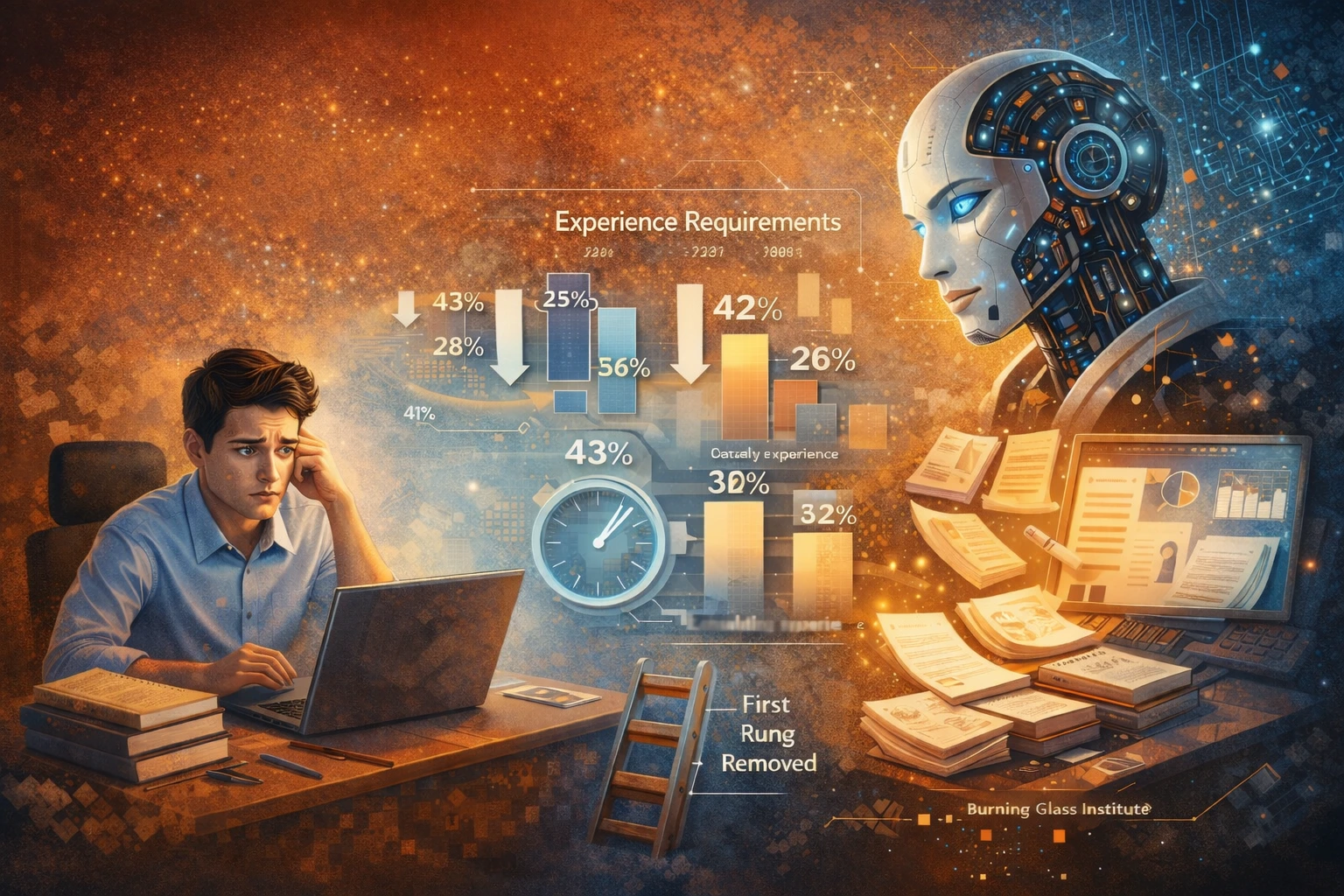
This has eliminated the traditional training ground. The Burning Glass Institute documented a dramatic shift in experience requirements between 2018-2024: software development jobs requiring three years or less of experience dropped from 43% to 28%, data analysis positions from 35% to 22%, and consulting roles from 41% to 26%.
The first rung of the career ladder has been removed.
An Islamic Perspective: The Principle of Istikhlaf
This isn’t the first time Muslims have faced massive economic disruption. When the industrial revolution transformed manufacturing, Muslim communities adapted. When colonialism restructured trade routes, Muslim merchants found new pathways. When the internet emerged, Muslim professionals learned to navigate digital spaces.
The Quran tells us that Allah taught Adam the names of all things (Quran 2:31), signifying that our unique capacity for knowledge, creativity, and moral judgment is part of our divine design. We are meant to be Allah’s khalifa—His stewards and representatives on earth.
AI is a tool created by human intelligence. It cannot replace the core of what makes us human and what makes us valuable in Allah’s sight: our ability to show mercy (rahmah), to make ethical judgments (hikmah), to build trust (amanah), to envision futures, and to act with ihsan—excellence and beauty in all we do.
Your Unique Value: The EPOCH Framework Meets Islamic Character
MIT Sloan researchers identified five categories of skills that AI fundamentally cannot replicate—what they call the EPOCH framework. Remarkably, these skills align almost perfectly with Islamic character traits:
Empathy (Rahmah)
Understanding and responding to others’ emotions remains uniquely human. The Prophet Muhammad ﷺ taught us: “The merciful are shown mercy by the Most Merciful. Show mercy to those on earth, and the One above the heavens will show mercy to you” (Tirmidhi).
In the workplace, this translates to conflict resolution, team building, and client relations. Lightcast data shows job postings emphasizing EPOCH skills increased 12% from July 2024 to July 2025.
Presence (Hudur)
Human connection, relationship-building, and physical engagement cannot be replicated digitally. Islam emphasizes presence in prayer (khushu), in community (jama’ah), and in family life. This presence translates directly to leadership, mentorship, negotiations, and authentic client relations that build long-term trust.
Opinion (Hikmah)
Ethical judgment and nuanced decision-making under uncertainty remain human domains. Allah says: “He gives wisdom to whom He wills, and whoever has been given wisdom has certainly been given much good” (Quran 2:269).
Erik Brynjolfsson’s research confirms that AI struggles consistently with management and complex judgment—exactly where human wisdom becomes most valuable.
Creativity (Ibda’)
Original imagination and novel problem framing are irreplaceable. Muslims have a rich history of innovation: algebra, universities, hospitals, architectural marvels. This creative capacity is needed more than ever as AI handles routine tasks, freeing humans for higher-order thinking.
Hope (Raja’ and Tawakkul)
Leadership, vision, perseverance, and inspiring others—these represent the human capacity to see possibilities and move toward them with trust in Allah. The Prophet ﷺ exemplified hope even in the most difficult circumstances, from the Hijrah to the Treaty of Hudaybiyyah.
The Profound Insight
The skills becoming most valuable in the AI economy are the exact same qualities Islam has been developing in believers for fourteen centuries. When you practice sabr (patience), you’re developing resilience. When you practice ihsan (excellence), you’re building intrinsic motivation and quality standards. When you practice amanah (trustworthiness), you’re creating reputation capital no algorithm can replace.
Your Islamic practice isn’t separate from your professional development—it IS your professional development.

Strategic Adaptation: The Path Forward
The World Economic Forum estimates 39% of core skills required in the job market will change by 2030. The gap between what employers need and what graduates possess has become the primary barrier to business transformation—cited by 63% of employers.
Skills Declining vs. Skills Surging
Declining:
- Basic research and writing (AI drafts and summarizes)
- Data entry and routine analysis (ML models automate processing)
- Routine coding and debugging (GitHub Copilot handles boilerplate)
- Basic customer service (chatbots resolve simple inquiries)
Surging:
- AI and big data literacy (45% of employers deem this “core”)
- Networks and cybersecurity (32% projected growth through 2032)
- Creative thinking
- Resilience, flexibility, and agility
- Curiosity and lifelong learning
The Credentialing Shift
Only 5% of surveyed companies now regard a college degree as mandatory for entry-level positions. However, 66% of leaders say they wouldn’t hire someone without AI skills, according to the WEF’s Future of Jobs Report 2025.
The message is clear: practical AI capability is more valuable than traditional credentials alone.
Recognized Certification Pathways
Job postings requiring AI skills have grown 109% year-over-year, yet only 35% of workers received AI training from their employers. This creates opportunity for self-directed learners.
Platforms offering recognized certifications include:
- Google Career Certificates (Cybersecurity, Data Analytics, AI Essentials)
- Microsoft AI Certifications (through the $4 billion Microsoft Elevate program)
- IBM AI & Data Science Professional Certificates
- AWS Machine Learning certifications
- DeepLearning.AI courses (43,000 enrollments in first 7 days)
GenAI course enrollments reached 6 enrollments per minute in 2024, up from 2 per minute in 2023.
The Canadian Advantage
For those in Canada, you have distinct advantages. Statistics Canada reports AI adoption among businesses doubled in one year—from 6.1% in Q2 2024 to 12.2% in Q2 2025. Critically, 89.4% of businesses using AI reported no change to employment levels.
Canadian tech talent grew 5.9% in 2024, compared to just 1.1% in the United States. Toronto ranks #3 in North America for tech talent, adding 42,900 tech jobs from 2021-2024.
Federal Support Programs:
- Canada Training Credit: Accumulates $250/year (lifetime limit $5,000), refunds 50% of training costs
- Digital Skills for Youth: Up to $25,500-$30,000 per internship
- Budget 2024: $2.4 billion committed to AI initiatives
Islamic Principles for Career Navigation
The Obligation of Seeking Knowledge
The Prophet ﷺ said: “Seeking knowledge is an obligation upon every Muslim” (Ibn Majah). In another narration: “Whoever travels a path in search of knowledge, Allah will make easy for them a path to Paradise” (Sahih Muslim).
When you invest time learning AI tools, completing certifications, or developing new skills, you’re not just advancing your career—you’re fulfilling a religious duty and trusting in Allah’s promise to ease your path.
Kasb and Tawakkul: Taking the Means
Islam teaches us the principle of kasb—earning through effort, taking the appropriate means while trusting in Allah’s provision. You cannot sit idle and say “Allah will provide.” Umar ibn al-Khattab (may Allah be pleased with him) saw a man neglecting his affairs and relying solely on prayer. Umar told him: “The sky doesn’t rain down gold and silver.”
The Islamic approach is clear:
- Recognize that rizq (provision) comes only from Allah
- But also recognize that Allah commands us to take the means
- The balance is tawakkul—trust in Allah AFTER you’ve done the work, not instead of doing the work
Maqasid: Higher Objectives in Career Choices
When making career decisions, Islamic jurisprudence teaches us to think about maqasid—the higher objectives. Ask yourself:
- Will this career path allow me to maintain my prayers, Islamic character, and family obligations?
- Does this field contribute to human benefit (maslahah) or does it potentially cause harm?
- Will I be working in an environment that respects my values or constantly challenges them?
- Am I choosing this path because of genuine interest and aptitude, or just fear and pressure?
Some income, even if technically halal, is not tayyib (pure and good). Choose paths that allow you to sleep peacefully knowing your skills contribute to genuine benefit.
The Opportunity Mindset: Entrepreneurship and Emerging Roles
AI hasn’t just transformed employment—it’s democratized entrepreneurship. For small business owners, AI automation tools are now accessible without enterprise budgets. Solo-founded startups without VC backing rose from 22.2% in 2015 to 38% in 2024. AI-native startups reach $1M annual recurring revenue in 11.5 months—4 months faster than traditional SaaS companies.
Sam Altman, CEO of OpenAI, observed: “It is probably possible now to start a company that is a one-person company that will go on to be worth more than a billion dollars.”
Emerging High-Value Career Paths
AI Prompt Engineering:
- Entry-level: $85,000-$95,000
- Senior-level: $150,000-$270,000+
- Job postings increased 150%+ year-over-year
Machine Learning Engineering:
- Average: $120,000-$190,000+
- 26% projected job growth 2023-2033 (6.5x faster than average)
AI Ethics and Governance:
- Entry: $100,000-$150,000
- Chief AI Ethics Officer: $200,000-$350,000
- Driven by EU AI Act and regulatory requirements
The broader pattern: AI-focused positions earn 18-56% more than comparable roles without AI requirements.
The Timeline Reality
How fast is this happening? Kai-Fu Lee’s 2017 prediction that AI would displace 50% of jobs by 2027—once criticized as too aggressive—now appears to be tracking accurately for certain sectors. The World Economic Forum projects 86% of businesses will be transformed by AI by 2030.
However, Brookings Institution analysis shows “more continuity than immediate collapse” in economy-wide employment data. The disruption is concentrated, not universal. Workers who adapt quickly have significant opportunity. Those who delay face compounding disadvantage.
The window for adaptation is measured in months, not years
The Theology of Rizq: Trust and Provision
Allah says in the Quran: “And there is no creature on earth but that upon Allah is its provision” (Quran 11:6). Every creature has their rizq guaranteed by Allah. But notice: Allah doesn’t say HOW that rizq will come.
The rizq for a bird comes when it leaves the nest to search for food. The rizq for a lion comes when it hunts. Your rizq will come, but it might come through paths you don’t initially see.
This is why tawakkul—trust in Allah—doesn’t mean passivity. It means you do everything in your power to prepare, to develop skills, to pursue opportunities, and THEN you trust that Allah will guide the outcome.
The Prophetic Example
The Prophet Muhammad ﷺ was himself a merchant, an entrepreneur. He traded goods, managed partnerships, built his reputation through excellence and trustworthiness. He took risks. He adapted to changing circumstances. He didn’t wait for opportunity—he created it while trusting in Allah’s plan.
When Khadijah (may Allah be pleased with her) offered him the business partnership that would change his life, he said yes. When Quraysh persecution forced Muslims to migrate, they didn’t sit in Mecca saying “Allah will save us”—they took the difficult, risky journey to Madinah.
Your AI-era career journey is similar. You must take the means (study, network, apply, build), trust the process (tawakkul), and believe that when you do your part with sincerity and excellence, Allah will open doors you cannot yet imagine.
Barakah Over Income
We often think success means having more—more money, more titles, more recognition. But Islam teaches us about barakah—the blessing and expansion that Allah places in our time, our work, our resources.
You might have a job that pays less but gives you barakah in your time to pray properly, spend time with family, pursue knowledge, serve your community. Another person might earn twice as much but have no barakah—constantly stressed, never satisfied, spiritually empty.
As you navigate this AI revolution, make choices that invite barakah, not just income. Some of the most financially successful people are deeply miserable. Some of the most satisfied people earn modest incomes but have peace, purpose, and barakah in their lives.
Conclusion: Don’t Compete Against AI
The graduates who will struggle most in this AI era are those who try to compete against AI—who try to be faster, cheaper, more efficient than the machines. You will lose that race.
The graduates who will thrive are those who recognize they were never meant to be machines in the first place. You were created as khalifatullah fil ard—Allah’s representative on earth. You were given unique capabilities of mercy, creativity, judgment, vision, and hope that no algorithm can replicate.
Your job isn’t to outperform AI. Your job is to leverage AI to amplify your uniquely human and uniquely Islamic qualities, so you can contribute to the world in ways that machines never could.
When you combine cutting-edge AI skills with timeless Islamic values, you become exactly the kind of professional the future economy needs and will reward.
As the Quran reminds us: “Indeed, Allah will not change the condition of a people until they change what is in themselves” (Quran 13:11).
Your condition can change, your opportunities can expand, your path can become clear—but it begins with you taking the first step with intention and trust in Allah.
Free AI Training Resources to Get Started Today
If there’s one thing to do in 2026, it’s to get AI certified. Not just for the badge—so you can actually use it at work.
5 Free Microsoft Courses Worth Taking:
1. Generative AI Career Essentials
The baseline for how GenAI works in real workflows, plus ethics and role changes.
Enroll: https://lnkd.in/gXAHuhFQ
2. Generative AI for Productivity
Prompting that improves output, better information structure, less busywork.
Enroll: https://lnkd.in/g_aq_R2k
3. AI Fundamentals Beginner Program
12-week technical track covering ML, NLP, neural nets, with hands-on labs.
Enroll: https://lnkd.in/gbyGV3Ni
4. Leading with Microsoft AI
Leadership track for AI strategy, scaling across teams, and responsible adoption.
Enroll: https://lnkd.in/gbzY-6GX
5. AI for Managers
Day-to-day management use cases for decisions, coaching, and team workflows.
Enroll: https://lnkd.in/gbgZmcGP
6 Free Harvard Tracks:
1. HKS GenAI (Strategy Track)
The open course wiki from Harvard Kennedy School.
🔗 https://generative-ai-course.hks.harvard.edu/spring-2024
2. CS50 AI with Python (Logic Track)
The logic behind the “Brain.”
🔗 https://cs50.harvard.edu/ai/
3. Data Science: Machine Learning (Builder Track)
Build the recommendation system.
🔗 https://pll.harvard.edu/course/data-science-machine-learning
4. CS50 for Business (CEO Track)
The manual for non-technical leaders.
🔗 https://cs50.harvard.edu/business/
5. Fundamentals of TinyML (Future Track)
Edge intelligence (IoT).
🔗 https://pll.harvard.edu/course/fundamentals-tinyml
6. High-Dimensional Data Analysis (Math Track)
For complex pattern recognition.
🔗 https://www.edx.org/learn/data-analysis/harvard-university-high-dimensional-data-analysis
(Note: For links #3, #5, and #6, select the “Audit This Course” option on edX to take them for free)
Which one are you starting with? Let’s make 2026 your best year ever! If you’re a business owner looking to leverage AI in your operations, book a free discovery call with Habib →